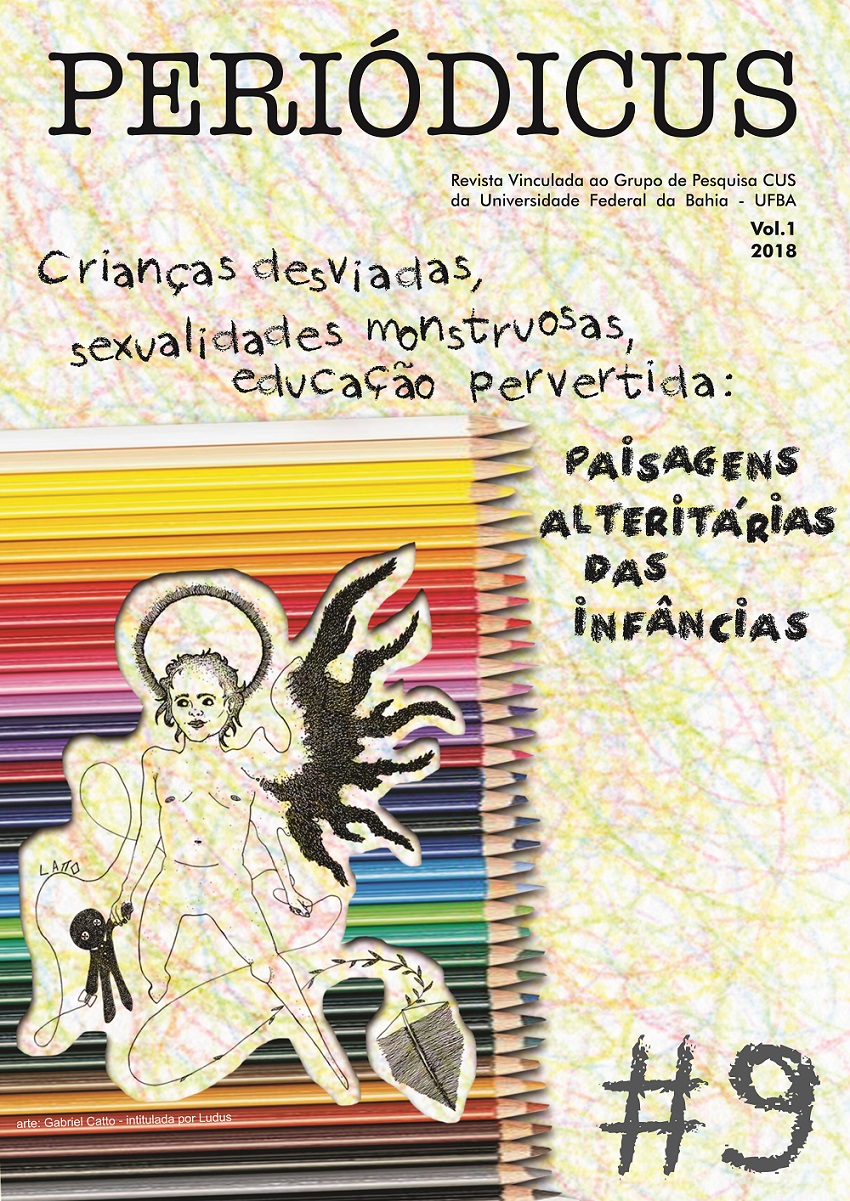
Notas sobre a Criança transviada: considerações queerfeministas sobre infâncias
DOI:
https://doi.org/10.9771/peri.v1i9.25755Abstract
Este texto contribui para uma análise crítica das questões políticas e de cidadania da figura da “Criança” e, de modo mais geral, da juventude, fazendo uma resenha da forma como a Criança tem sido construída enquanto um corpo ‘natural’, branco, heterossexual, patriarcal e classista. Esta resenha é feita a partir de várixs autorxs queer e feministas, e a sua leitura conjunta mostra como o conceito tem sido historicamente usado para sustentar o heteropatriarcado branco de classe alta, e como esta ordem discursiva continua a ser reintegrada pelo feminismo liberal e pelo movimento LGBT mainstream. O artigo encerra com um ponto de resistência: a partir da crítica de Edelman e das releituras que Stockton faz a várias obras famosas, considera-se como a Criança pode ser lida enquanto transviada, e como esse processo é fundamental para a dissolução de sistemas discriminatórios de cidadania que naturalizam relações de dominação e objectificação política contra certos corpos, considerados dissidentes, cujo crescimento não é visto como ‘ortopedicamente’ correcto.
Downloads
Downloads
Published
How to Cite
Issue
Section
License
Copyright (c) 2018 Revista Periódicus

This work is licensed under a Creative Commons Attribution-NonCommercial 4.0 International License.
Authors who publish in this journal agree to the following terms:
Authors retain copyright and grant the journal the right of first publication, with the work simultaneously licensed under a Creative Commons Attribution Noncommercial License that allows the work to be shared with acknowledgment of authorship and initial publication in this journal, but prohibits commercial use.
Authors are authorized to enter into separate additional contracts for non-exclusive distribution of the version of the work published in this journal (e.g., publishing in an institutional repository or as a book chapter), with acknowledgment of authorship and initial publication in this journal.
Authors are permitted and encouraged to publish and distribute their work online (e.g., in institutional repositories or on their personal website) at any point before or during the editorial process, as this can generate productive changes and increase the impact and citation of the published work (see The Effect of Open Access).