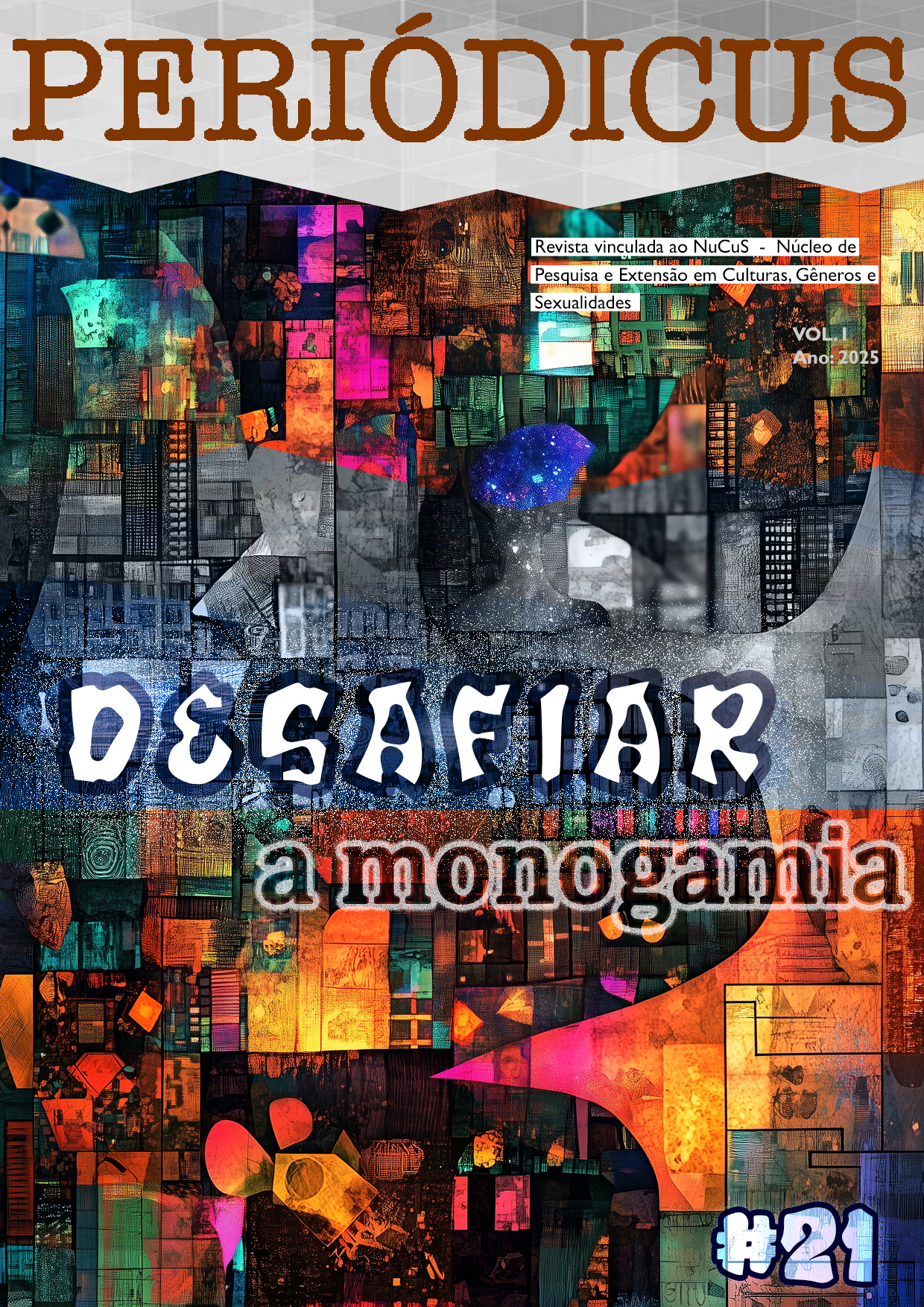
(Non) monogamies and imaginaries
the elaboration of emotions in verb-visual plots
DOI:
https://doi.org/10.9771/peri.v1i21.58749Abstract
Providing language to the emotions we feel allows us to glimpse contours that were previously unnoticed and also gives us the opportunity to narrate to ourselves what we first came to know through our bodies. Here, I assume that our affections are also the result of verbovisual plots: networks woven by images, discourses, values, practices, and imaginaries. With this essay, I aim to reflect on some of these images that coconstitute us as socially located and represented subjects, guided by an affective pedagogy monogamously oriented, as well as visually arranged. Mobilizing the concept of “image”, proposed by Gonzalo Abril (2012), I wonder how its three visual dimensions – material, imaginary, and gaze – can help us reflect on how non-monogamies act as sensitivities of reparentalization with the world and emotional re-elaboration, outlining other possible ways of inhabiting.
Downloads
Downloads
Published
How to Cite
Issue
Section
License
Copyright (c) 2025 Ítalo Vinícius Gonçalves

This work is licensed under a Creative Commons Attribution-NonCommercial 4.0 International License.
Authors who publish in this journal agree to the following terms:
Authors retain copyright and grant the journal the right of first publication, with the work simultaneously licensed under a Creative Commons Attribution Noncommercial License that allows the work to be shared with acknowledgment of authorship and initial publication in this journal, but prohibits commercial use.
Authors are authorized to enter into separate additional contracts for non-exclusive distribution of the version of the work published in this journal (e.g., publishing in an institutional repository or as a book chapter), with acknowledgment of authorship and initial publication in this journal.
Authors are permitted and encouraged to publish and distribute their work online (e.g., in institutional repositories or on their personal website) at any point before or during the editorial process, as this can generate productive changes and increase the impact and citation of the published work (see The Effect of Open Access).